Lightning and Thunder
Lightning
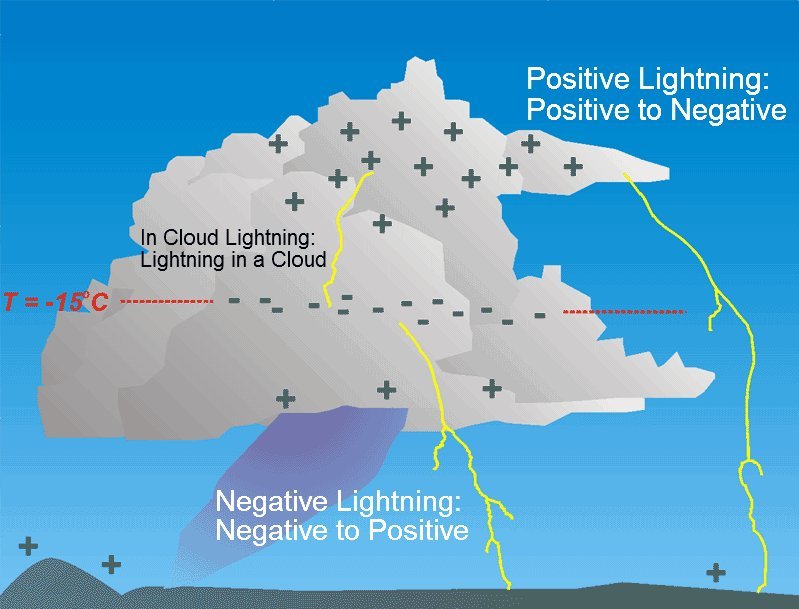
Lightning is basically electricity. Its formation starts inside cumulonimbus clouds. Inside a cumulonimbus cloud, water droplets, hail and ice crystals are constantly colliding. These collisions form positive and negative charges. The positive charges accumulate at the top and a thin line of them at the bottom. The negative charges accumulate at the bottom. When the two charges connect, lightning forms.
Lightning Bolts (the ones that makes contact with the earth)
1.Negative Lightning
When enough negative charges build up, it will be able to start going through the atmosphere. The negative charges go down through a channel called a "stepped leader" at about 200,000mph. Since negative and positive charges attract each other, positive charges on the ground will go up towards the stepped leader on a channel called a "streamer". Streamers can rise through buildings, trees and even people. Note: people can't see stepped leaders or streamers. When the stepped leader makes contact with the streamer, negative charges will stream down into the earth while a visible flash of lightning streaks upward at 200,000,000mph.
2.Positive Lightning
Positive lightning forms almost the same way, except the stepped leader is made up of positive charges instead of negative, and the streamers are of a negative charge instead of a positive charge. These types of lightning bolts are much more powerful for they need to travel through much more atmosphere (these positive charges are at the top of cumulonimbus clouds) thus has a much higher voltage. Less than 5% of all lightning bolts are positive.
Thunder
Thunder is the sound caused by lightning. It is formed because the air will instantly expand from the extremely hot temperature of the lightning (16650-27760°C) touching it. When it expands, it'll send out a vibration that you will hear as thunder. If you are very close to the point of impact, it'll sound like a sharp crack. If you are far away, it'll sound like a low rumble. Thunder is heard after you see lightning. To find out how far you are from the lightning strike, count the seconds between when you see lightning and when you hear thunder. Divide this number by five. That is distance in miles of how far away it is.
